Figuring out what size baseball glove you need starts with two facts: throwing hand and position. From there, sizing follows general ranges rather than one fixed number. Infielders typically use shorter, shallower gloves for quick transfers, outfielders use longer gloves for extra reach, and pitchers favor a mid-range length that helps conceal grip. These ranges are helpful starting points, not strict rules, and the right glove ultimately comes down to how it measures against the player’s own hand and how it feels in use.
What Do You Need Before Sizing a Glove?
Two things settle any glove-sizing question before you ever pick up a tape measure: throwing hand and position. Skipping either step leads to a guess rather than an informed choice, and confirming both up front helps players and parents avoid mismatched fits and unnecessary returns.
Which hand does the player throw with?
Throwing hand determines which hand wears the glove. A right-hand-throw player wears the glove on the left hand, while a left-hand-throw player wears it on the right. Confirming this detail before anything else prevents an easy but costly mistake.
Position comes next, since infield and outfield gloves differ in length and pocket depth. Boa Custom builds gloves position by position, so getting throwing hand and position right at the start matters just as much for a custom glove as it does for one bought off a shelf.
Does a custom glove still need standard sizing steps?
Custom construction does not replace measurement, it refines it. Boa Custom’s design process lets a player build a glove around their own hand size and position rather than a generic size run, but that process still starts with the same fundamentals: confirming throwing hand, position, and an accurate length measurement first.
How Is Glove Length Measured?
Glove length is measured in inches along the outside of the glove, from the top of the index finger to the heel at the bottom of the glove, following the curve of the leather rather than a straight line across it. This is the number printed on size charts and stitched into most gloves, and it’s the primary spec that separates one glove size from another.
Glove length is not the same as hand size. Hand size refers to the player’s actual hand, typically measured from the wrist crease to the tip of the middle finger, or around the palm for width. Two players with similar hand sizes can still prefer different glove lengths depending on position: an infielder with a six-inch hand length might size down for a faster transfer, while an outfielder with the same hand length might size up for extra reach. Checking both numbers, rather than assuming one determines the other, leads to a better fit.
Baseball Glove Size Chart by Position and Age
The ranges below are approximate starting points. Actual fit still depends on the player’s hand size, comfort, and how the glove feels once it’s on.
| Player Group | Typical Glove Length | Why |
|---|---|---|
| Youth infielders (roughly ages 6-12) | 9″ to 10.5″ | Smaller hands need a shorter glove for control and a manageable pocket |
| Youth outfielders (roughly ages 6-12) | 10.5″ to 11.5″ | Slightly longer than youth infield gloves for early reach and fly-ball tracking |
| Infielders (teen and adult) | 11″ to 11.75″ | Shorter, shallower pocket for a quick glove-to-hand transfer |
| Outfielders (teen and adult) | 12″ to 12.75″ | Longer length built for tracking and securing fly balls at full extension |
| Pitchers (teen and adult) | 11.5″ to 12″ | Mid-range length that helps conceal grip and ball position |
| First basemen | 12″ to 13″ (mitt style) | Longer surface area for scooping throws in the dirt |
| Catchers | Sized separately (mitt, not glove length) | Mitts use their own sizing system built around blocking and framing |
How Do You Match Glove Size to Position?
Position determines glove length before anything else does. Each defensive role calls for a different balance of reach, control, and closing speed.
Follow these steps to match a glove to the position played:
- Identify the primary position: pitcher, first base, middle infield, third base, outfield, or catcher.
- Note that pitchers and third basemen typically use a mid-range length suited to quick transfers and reaction plays.
- Recognize that first basemen and outfielders benefit from longer gloves built for scooping and extended reach.
- Confirm that infield gloves stay shorter overall, favoring a fast release over the extra coverage outfielders need.
- Separate youth ranges from adult ranges, since youth charts run smaller across every position.
What’s the difference between infield and outfield glove sizing?
Infield gloves favor a shorter, shallower pocket that speeds up the transfer from glove to throwing hand. Outfield gloves run longer, built for tracking fly balls and securing them at full extension. The difference reflects the job each position performs.
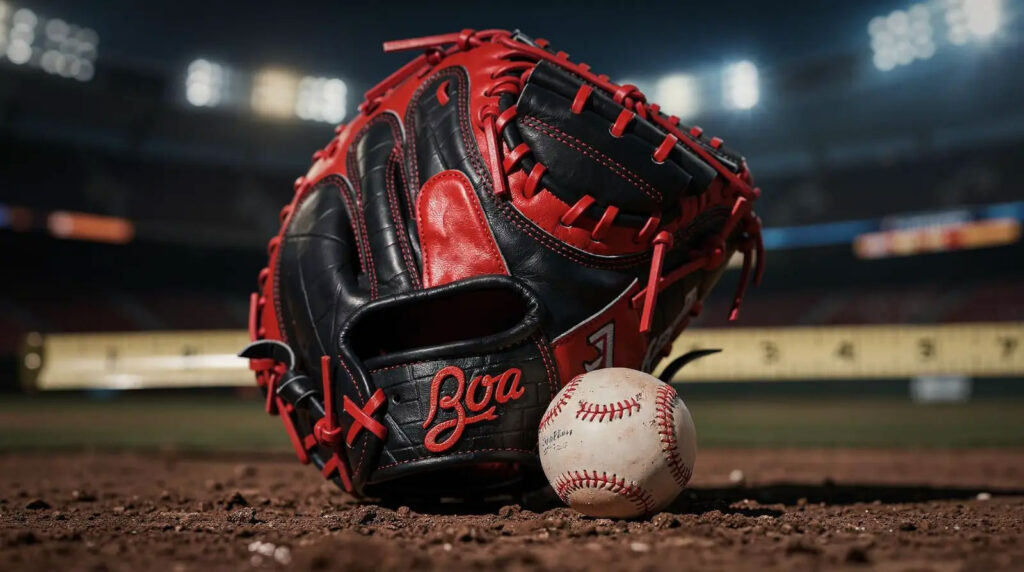
For example, a 10-year-old infielder with a hand length around six inches typically fits comfortably in a glove near the shorter end of the youth infield range, while a teenage outfielder with a larger hand may need a glove closer to 12.5″ to get the extra reach that position calls for. Sizing charts split further by age and competitive level, giving separate youth and adult ranges for both infield and outfield roles. A player who outgrows a chart-standard glove, or who wants a fit built around their own hand measurements, has an alternative: Boa Custom builds each glove to order rather than pulling from a fixed size run, so players can order a glove matched to position, age, and hand size.
How Do You Check Hand Fit in a Glove?
Once a size looks right on paper, checking it on the hand confirms the fit. A few things to look for:
- Fingers should reach close to the top of the finger stalls without jamming or leaving excess empty space at the tips.
- The web should sit naturally in the hand when the glove closes, without requiring an awkward reach or grip.
- The wrist strap should close snugly enough to keep the glove secure through a swing of the arm, without cutting off movement.
- A new glove will feel stiffer than a broken-in one, so allow for some natural loosening with use rather than judging fit on the first try alone.
Choosing Between Two Sizes
When a player is between two sizes on a chart, a few practical guidelines help:
- Younger or smaller-handed players generally do better sizing down, since a smaller glove is easier to close and control.
- Players prioritizing reach, outfielders in particular, often do better sizing up within the recommended range.
- A glove that needs to last through a growth spurt can lean toward the larger end of a range, since leather breaks in and softens with use but does not shrink.
- When in doubt, hand fit and comfort should outweigh the exact number on a chart.
What Mistakes Should You Avoid When Choosing Sizes?
Skipping careful measurement is the most common and most costly error. Since a custom glove is built to the measurements provided, confirming hand orientation and length before ordering matters far more than it would with an off-the-shelf glove that can simply be exchanged.
What if a player isn’t sure which size or pattern to choose?
Uncertainty happens, especially with a custom order. Players and parents who aren’t sure which size fits best can contact Boa Custom directly to talk through sizing before placing an order.
Common mistakes to avoid:
- Guessing at hand orientation instead of confirming right-hand-throw or left-hand-throw
- Relying on glove length alone without checking how the glove actually fits the hand
- Placing an order without measuring against the player’s current hand size, especially for a growing youth player
Frequently Asked Questions
What size baseball glove do I need?
It depends mainly on position and hand size. Infielders generally use 11″ to 11.75″ gloves, outfielders use 12″ to 12.75″ gloves, and pitchers use 11.5″ to 12″ gloves, with youth players sizing smaller across every position. These are starting ranges, not fixed rules, so hand fit should always confirm the final choice.
How do I measure a baseball glove?
Glove length is measured in inches along the outside of the glove, from the tip of the index finger to the heel at the base, following the curve of the leather. This is the number used on sizing charts and is different from a measurement of the player’s hand.
Is glove length the same as hand size?
No. Glove length describes the glove itself, while hand size describes the player’s hand, usually measured from the wrist to the fingertip. Two players with the same hand size can still need different glove lengths depending on position and personal preference.
Are position-based glove size ranges strict rules?
No. They’re general guidelines based on what tends to work well for each position. Actual fit still depends on the individual player’s hand size, comfort, and how the glove performs in use, so a player can reasonably size up or down within reason.
Does building a custom glove skip the standard sizing steps?
No. A custom order builds on the same sizing fundamentals rather than skipping them. Boa Custom confirms throwing hand, position, and hand measurements at the outset, then tailors length and fit to the player from there.
Conclusion
Selecting the right glove size for a player’s position is a practical step toward better fielding and more comfortable play. The right length supports quick transfers for infielders, extended reach for outfielders, and secure control for pitchers, while hand fit and comfort should always have the final say over a chart number alone. Boa Custom builds gloves to order around a player’s position, age, and hand size, giving players and parents a way to get a fit that a standard size run can’t always match.